Showing posts with label apartment technology trends. Show all posts

Sunday, April 28, 2013

Stop Looking for the One-Stop Shop

Would you want the company that built your marketing website to handle your accounting?


It might sound ridiculous, but it's not far from the current view of software vendors held by many in the apartment industry. Accounting software providers provide marketing websites, payment processing, email marketing and more. Online advertising sites (ILSs) provide blog content, social media tools and online reputation monitoring. The list goes on.


We expect our vendors to provide solutions to help us grow our apartment businesses.


Yet I think we ask too much of industry software vendors. And ultimately, it's our own apartment businesses that suffer because of it.


I once had a client tell me they couldn't consider best-of-breed solutions to manage their digital marketing. Staff turnover was high, so adding more tools to the training regimen would cost too much. Rather than going with the best email marketing tool available, they went with the inferior solution offered by their property management software. Why? Because they had convinced themselves that the one-stop shop was the way to go. (They've since changed their stance, and they now have an award-winning marketing team regularly looking for tools to help them do their jobs better.)


The notion of the one-stop solution is exactly the issue that keeps people from seeking better options. We've put too much on our onsite people, and we've trained ourselves that, when staff turnover is high, it's too hard to train people on multiple software systems. The one-stop solution is a "better fit" and there really isn't another option.


Stop sign

Building a Successful Platform

Now take a look at Saleforce.com. Or Apple's iOS. Or WordPress. Or MailChimp.


All have built incredibly successful businesses by not trying to do it all.


Instead, they've each focused on building a robust, flexible platform as the base for their core function (CRM, mobile computing, website management, and email marketing, respectively). But instead of bolting on anything that resembles a potential customer solution, all of these platforms have opened themselves up to other developers -- companies that are often much, much better at a given area of expertise. Instead of building everything in-house, they have vast resources available to their customers through apps, extensions, plug-ins and APIs. Want to get more out of your iPhone? Download an app. Need your website to do something specific? Add a plugin.


It's time for an approach like this to take hold in multifamily. We don't need one-stop solutions. We need software vendors perfecting their craft in specific areas, then openly sharing their data (your data, really) with complementary systems to provide you with effective tools to run your business.


Openness Will Take Time

This "open platform" approach won't happen overnight. (Property Solutions is taking the first steps toward a "platform as a service" with Entrata, which could be a good sign that we're heading in the right direction.)


Although it's a proven model in other industries, the open platform has yet to take hold in multifamily. Vendors are just starting to open their data (again, your data), and many of owners and property managers are just starting to look outside the industry for appropriate tools and solutions.


Even just recently, I saw the following comment in a LinkedIn discussion:
"I think the problem is as follows: Though there are many very strong providers providing comprehensive solutions, the market is so vast that users aren't aware of all the options available to them. The users; businesses have changed, too, so that when a small-scale solution might have worked when the company or property was smaller, there is a real need for a one-stop solution at a later stage of development. Platform as a Service (PaaS?) is a great concept, one of which I had not heard before."


Of course, none of us could possibly know about all the options available to us. If we're honest with ourselves, we also know that no vendor can truly provide comprehensive solutions. We need to start asking better questions, looking for the software tools and solution providers that will truly help us take our businesses to the next level -- some cater specifically to the apartment industry, others may not. I wouldn't expect the accounting team to handle my marketing, and I'm not sure you should, either.


The idea of open software systems is long overdue in multifamily. It's happening for small business and many other industries (check out The Small Business Web as an example). Kudos to PSI for taking the first steps toward an open future. Who's next?


Tuesday, October 23, 2012

Get Ready for Ultra HD

According to Nielsen, over 75% of U.S. households have a high definition TV. You probably already know that a lot of your residents are included in that number.

The "next" thing was supposed to be 3D TVs, but those have been received with mixed reviews. (Who wants to wear those special glasses?) But don't look now ... there's an entirely new option right around the corner, and it's something you should keep an eye on: Ultra HD TV.

UltraHD TVs look amazing. A typical HD television has a resolution of 720-1,080 rows of pixels on the screen; Ultra HD promises at least 4 times that resolution. There's a whole set of standards that has already been developed, and the first models could start hitting store shelves as early as this holiday season.

What does it mean for multifamily?

Use it as a Leasing Tool. First, it might be worth upgrading in your leasing offices and amenity spaces. If you have high-res videos or photos of your property, there's no better way to showcase them than on a beautiful display. If you don't have high-res photos and videos of your property, get some ... it's worth it.

Do a Network Double-Check. For your residents, it will be more important than ever to have a solid video network for your property. Video providers will be moving to provide content for these ultra-high resolutions, and it's not going to look very good if the resident can't get a decent signal to their living room. Talk to your service provider, or have a low voltage consultant review your site infrastructure (and any agreements you have in place with your providers).

Customer (Electronics) Support. Also, UltraHD TVs are huge ... sometimes 84 inches and bigger. Can your walls handle that if a resident tries to mount a 80+" TV on the wall? It might make sense to review your outlet plan in the apartments to make sure the layouts still work. In many cases, we're seeing our clients and other multifamily developers add extra outlets (and reinforced walls to support the weight of the TV) at the height where the resident would typically mount the display.

As the holiday season approaches (and the Consumer Electronics Show in January), keep an eye on these devices. Look for the empty boxes out by the dumpsters. Hopefully there isn't too much you need to do to prepare your property, but keep these points in mind if you start to see an increase in complaints about the TV service in the months ahead.

Tuesday, November 08, 2011

NMHC OpTech 2011: Top Tweets from Day One - #NMHCTech

Many in the industry have descended on Dallas for this year's edition of the NMHC Operations and Technology Conference, which kicked off yesterday with a keynote presentation from futurist Jack Uldrich.

In case you couldn't make it to the conference (yours truly included), here are some of the highlights from those in attendance at yesterday's sessions, 140 characters at a time:


Want to follow along during today's roundtable discussions and sessions? Just follow the search #NMHCTech.

Monday, October 24, 2011

How Much Bandwidth Does Your Property Need for the "Internet of Things?"

So you think a 3Mb connection for each resident is sufficient? Maybe 5-10Mb if you have "tech-savvy" residents like students?

Sorry, that's just not going to cut it.

Take a look at the graphic below, shared by Cisco. (If there's any company that knows networking, it's them.) The money stat?

"By the end of 2011, 20 typical households will generate more Internet traffic than the entire Internet in 2008."

That's only three years ago, folks.

This goes way beyond websites and email ... the "Internet of Things" includes devices that have never been part of the network before (think appliances, access control systems, lighting systems, background music, sprinkler systems, etc.). Considering that the typical apartment community is often 200 households or more, that's a LOT of bandwidth. (Netflix usage alone can be enough to slow Internet speeds to a crawl at many properties.) If we assume that a fair number of these devices will be wireless, that's also a LOT of Wi-Fi spectrum getting pounded ... so be aware of potential interference issues. And all of this doesn't even account for any devices that property owners are installing to help properties run more efficiently.

The question is, what are you doing about it now to make sure you aren't losing these connected residents later? How are your ISP partners stepping up to help address potential bandwidth bottlenecks at your property? (Even if the numbers shared here don't pan out by the end of the year, it can't be that far off.)

I'd love to hear how you're planning for the "Internet of Things" and how it will affect multifamily (positively or negatively).

by visually via

Tuesday, March 22, 2011

IPv6: The new Internet Protocol and why you should care

This is a guest post from Bill Szczytko. Bill is the IT Manager for Maryland Management who loves handling the challenges of driving prospects and creating computer programs. Read more from Bill at BSitko.com.

* * * * * * *

Some experiences in life can turn your bad mood into good. A love note from your spouse, a smile and kiss from your kids, your mother-in-law staying for the weekend ... okay, maybe not that one.

There are other things, like learning about Internet Protocol ANY version, that do just the opposite. Why then should you continue reading any further? Sure, this topic might be considered by some to be "Boring but important" but this stuff is crucial to understanding where the internet is headed. The Internet as you know it HAS to transform over the next few years or it risks not working at all.

There's lots of Geek language in here. To help ease your pain I'll be slapping up these icons Geek to let you know when the Geekery is about to get pretty deep. Feel free to skip that section, look it up for more information, or stab yourself in the eye with your pen.

What is Internet Protocol? Does it have anything to do with Facebook?

The internet as you use it today relies on a method of communication called Internet Protocol v4. No matter the device you use, this protocol is getting you online.

LandytownLet me give you an example: let's just assume that the internet is a made up town in America. Every house in this town has its own unique address. That's no different from real life right? It would be pretty confusing to the USPS if people in the same town had the same address. How could you get your mail delivered? You'd end up with a brown bag covered magazine and someone else would have your AARP membership card. Chaos.

Next, think about how you'd get to someone's house in this town. You write down their address, look up the directions on Google Maps, and find out the route to take to get there. When you type http://www.google.com into a web browser, Internet Protocol needs to look up the address too. It accomplishes this look up using Domain Name System. Once it finds out the route to get there, it then "drives" your packet of data to the destination FAST.

So every device that wants to use this Internet Protocol thingy needs a unique address?

Yup. In some form or another. (I'll explain that sentence in a minute.) Unlike my real world example where you're just driving over to someone's house, Internet Protocol is a two way street. Which means running over to Sally's for a nooner would require her to then come back to your house. That won't work. See, once your packet of data has been given the correct address to go to ... that packet needs to get home. It's why the packets have to be able to find each other; hence why they must be unique. Geek  The IPv4 spec (Geeks love calling things spec) uses 32-bit addresses which limits you to only 4,294,967,296 possible unique addresses. That's a ridiculous amount of addresses. Except there's one problem; by the end of this year, we'll be out.

"Honey, put the Private sign on the hotel room door and come here."

Hotel roomYou might find this really crazy, but we would've been out of addresses a long time ago except for one thing. Private addressing. I won't pretend to know the makeup of your corporate offices but I'm willing to bet they use a private address scheme. Typically when computers are in the same building, they will all communicate with each other. Geek  There's no reason why they all need to have their own unique internet address and so under the Private address scheme they can share one.

GeekGeek  Here are the 3 ranges of private addresses:

* Class A: 10.0.0.0 - 10.255.255.255
* Class B: 172.16.0.0 - 172.31.255.255
* Class C: 192.168.0.0 - 192.168.255.255

Hey ... you! Wake up! Stay with me now. I thought I'd lost you. You were sleeping pretty hard there. Bottom line is these private IP's are not routable; meaning Internet routers will ignore devices that have these addresses. Because they aren't routable on the INTERNET you can use them for private addresses. You can then have multiple devices all talk to each other and yet share only one Internet IP address. Get it? Good ... let's move on.

So we need IPv6 because even with private addresses we're STILL running out?

You're a fast learner. Back in the mid 90's IPv6 was chosen because some seriously smart Geeks saw the end of the internet. The new version gives you an absolutely ridiculous amount of addresses that you can use. Geek  It's based on 128 bits vs 32 bits as IPv4 was. This means that we'll have 340,282,366,920,938,463,463,374,607,431,768,211,456 available addresses. Yes ... umm, THAT number. I mean honestly I don't even know how to say that. Just crazy. (It's undecillion actually.)

So if IPv6 has been out since the late 90's why aren't we fully using it yet?

Well, that's the real question right there isn't it? Remember ... every device in existence today uses IPv4. Most routers are still using it, servers, workstations, Internet lines ... the entire backbone of the internet is still utilizing it. People don't like downtime so how do you convert EVERYTHING to the new spec? For now IPv4 and IPv6 are working side by side. Remember that this is a software problem. Network cards and network switches could care less what spec you're using but still, how do you get every device to start speaking a different language and not mess stuff up?

Slow and steady wins the race

Over time everything will need to be converted. As multifamily companies just trying to grasp the impact social media has on our business, should we even shifting our attentions for this? Yes. Here are some things I think you should do to get ready:

* Find out if your IT staff is trained in IPv6. I've glossed over the complicated topics here but trust me when I tell you that reading the IPv6 specification on a full stomach is bad. If your IT staff doesn't understand IPv4, then they aren't really your IT staff but terrible imposters. Knowing IPv4 isn't enough though. It will take some reading and research before they're ready to take on IPv6. Before you just barge into the IT staff's office to tell them about this make sure you call first ... you don't want to interrupt them playing World of Warcraft. Just sayin'.

* Is your network provider ready? Is your internet service IPv6 ready? It's going to take some phone calls but before you can start using IPv6 on the internet, you'll need your internet to be IPv6. Wow, talk about redundant.

* Is everyone running an IPv6 ready Operating System? Windows XP has had support since SP2 but it's off by default. Windows Vista (CRAP!) and 7 have it on and ready by default. OS X has had support since version 10.4.8. How up to date are your operating systems and if not what will it take to get them there?

* What about your actual applications? Can they handle IPv6? This will require talking to your PM vendors as well as your web hosting vendor. Switching your network over only to find out you can't run Yardi internally would be very very bad.

So there you have it. IPv6 is coming to an Internet near you. No one is saying you need to switch tomorrow but plans should be in place to begin your transition. This new protocol isn't going to rent you new apartments, it won't turn your units faster, and it won't keep your staff motivated but it will insure that everyone can access email, your property management software and Facebook. Now, what is more important than that?

Thursday, January 06, 2011

Over-Hyped Technology You Think You Need But Probably Don't Yet

This is a guest post from Bill Szczytko. Bill is the IT Manager for Maryland Management who loves handling the challenges of driving prospects and creating computer programs. Read more from Bill at BSitko.com.

Since the advent of the AS400, we've been hankering away for technology to help us rent and manage apartments. We seek it out in the corners of the Internet, we buy into every single ILS that comes along and we attend every conference in the hope that something will help us rent that apartment we've had sitting for 6 months. We are like addicts and there are plenty of vendors out there who know it.

Skepticism is good. When it comes to purchasing though I am pretty skeptical about everything. It's good to be that way. There's nothing wrong with making sure new technologies fit. The things I'm going to talk here about ARE good technologies. Are there clear and legitimate reasons behind the hype? I'll let you decide:

Revenue Management.

This is probably the #1 technology running rampant around the industry today. You're probably horrified that I included it here. Just because the top folks are pumped about something doesn't mean the smaller fish need to give a hoot. Here's my cautionary tale:

Pushing your rents. Duh. This is the fundamental methodology for increasing your NOI. A lot of industry professionals live by the vacancy percentage. While it is certainly relevant, it is just one piece of the puzzle. It's possible to have a higher NOI with an 8% vacancy than a 4 or 5%. My point is that you should be pushing your rents anyway. Let me let you in on a little secret. You don't need a computer system to tell you that it's okay to push. You know your market, you know your personnel, don't replace that knowledge with just a computer system.

Comparable information isn't very reliable. Revenue Management systems include this data in their number generation. Most people that have been in this industry for a while know that this data is terrible. You call around ... the agent remembers what the price was last week but it's gone down since then. They're having a bad day and don't feel like researching. Or they know you're the competition and want to mess with you. Pick your excuse ... these numbers don't really tell the whole picture. Use them as a baseline ONLY. Are you comfortable using systems that use this data? Lots are ... are you?

Changing your rents daily causes chaos. How can you successfully manage and market all of your online sites and paper advertising when the price today isn't the price tomorrow? I understand that hotels turn most of their people daily and so these daily (or hourly) price changes really do benefit them. We don't turn that many apartments daily, weekly or even bi-weekly. It's hard for me to fathom conditions that require prices to jump around so often. It makes renting apartments difficult. I truly believe that the 6 through 15 month price grid can be intimidating for some at first. Is there such a thing as too many choices? Prospects just want to know how much it is per month. They saw $899 and they want that ... after all, it was just yesterday.

"Holding an Apartment" online.

Sometimes too much information is just that. Too much. Certain managers have apartments that they like to push. Whether it's a higher commission bonus or a better value; no one can do it better than your agents. The Internet offers great information to your prospective residents. They are more empowered than ever to make smart decisions. At the end of the day they want to put their hands and eyes on what apartment they are going to live in. It's a yearly commitment. It isn't a 1 or 2 day stay. Hard to convince me that most people will commit sight unseen.

Higher Conversions? I'm sure that the conversions from "holding" an apartment are higher than normal. How it can hurt you is it pulls apartments off of your availability that you might be able to rent to your other qualified people. Is it worth it to you to hold an apartment for $10? You could also be affecting your rent amounts (check my topic #1) for that unit type just because two buddies got hammered and reserved some apartments. It is a much stronger commitment to hold an apartment while in the office than online ... $10 not withstanding. I would love to see numbers on how many people actually pay the fee and what rent range the apartments are.

Twitter.

Blasphemy! Twitter is a fantastic medium to engage with others. It's one big cocktail party 24 hours a day. Your residents are people with lives. They have families, kids, parents, drama, and bills. Just like you and I. I feel that what a lot of residents want from their Property Management company is transparency. Come and fix their sink when it's clogged and accept their rent but otherwise stay out of their lives. For those that don't want you to stay out ... they'll use Facebook. It's a much better place to engage with your residents. Sure, use Twitter to listen to what others are saying about you. But from our experience thus far, it's been virtually no one. Do we advertise our presence on Twitter? A little. But we see no need to. No one wants to engage us there. Someday? Maybe ... but not now.

iPad.

I'll be honest, when I first heard about this "thing' I was intrigued. Apple is known for pushing the boundaries of interaction with their devices. This thing is an interaction grand slam. It's amazingly cool and using it is a pleasure. Once I hit the lottery I'll go out and purchase one. For the majority of us Property Management folks is it really going to rent us more apartments? Will we see NOI increases once it hits our leasing offices? I'm skeptical.

Is being cool ... enough? As I said, you know you want one. That's the pull I think that's driving this "We have to invest in this" fad. Are there some relevant technologies you can use with it? Sure. Property Management systems will not work on it. For those of you that use VaultWare (They will never talk to me again I'm sure ... read #2) they do offer an iPad application. Sure you can enhance tours with this thing. But I revert back to my original point: will it REALLY rent you more apartments? Come on ... think about it. If it truly does that I'd have to question your leasing agents ability to rent. Ouch (sorry I know), I'm extra cranky today.

Property Management Software.

Okay, ha ha... this last one is just to see if you're paying attention. We love our Property Management software. It does everything we want it to do with hardly any fuss. They are so intuitive, aren't they? I do want to mention one thing though. I would love to see more players in the field. Yardi and OneSite are awesome software packages but they come with so many features that most smaller fish don't need. We all probably only utilize 45 - 55% of our current PM software yet you pay for 100% ... remember that.

Conclusion? Don't cancel your LRO or VaultWare. Don't delete your Twitter handle. But if you're thinking about these technologies remove the NEW FACTOR and ask yourself before you invest your money whether it's right for you and whether you actually NEED it. I urge caution and skepticism before you dive into any new technology you see.

Afterthoughts. I'm a skeptic. It's what I do. I love technology and I personally jump on the bandwagon for everything new. The companies I mentioned are all leaders in our industry and have created excellent software packages. I am trying to generate conversation, and I'm hoping you'll participate.

Happy renting, everyone.

Tuesday, November 23, 2010

NMHC 2010 "OpTech" Conference: Try It, Analyze It, Improve It

This recap of the 2010 NMHC Apartment Operations and Technology Conference is a guest post contributed by Kim Duty, VP of Communications for the National Multi Housing Council.

How to Do Business Smarter, Quicker, Better

Leading apartment executives gathered last week in Dallas, TX for the 2010 National Multi Housing Council Property Operations and Technology (OpTech) conference. While there was a lot of healthy debate at the conference, it is clear that sophisticated technology-based tools have dramatically changed the apartment industry in the last 10 years. From marketing to pricing to data mining, apartment companies are leveraging technology to transform their communications and their operations.

As AMLI’s Greg Mutz noted: “In an information age, information is the currency of the realm. We are trying to use tools to reduce procurement costs, increase productivity and increase residents.” And he added that authorizing sufficient training dollars is critical: “These tools are only as good as the people using them, so don’t be cheap about training. The Israelis have the same airplanes as everyone else but they use them better because they train better.”

Deane Dolben of The Dolben Company cautioned that “it’s easy to spend more on technology than it will deliver back, especially for a medium-sized company. We focus on our people and make sure they don’t forget about doing their job because they’re spending so much time on technology.”

If there was one theme at the conference it was the need to continue to advance the industry's embrace of technology to do business smarter, quicker, better. "Go out there, try it, keep analyzing it and change it to improve it," said one presenter. And if you want to know where technology is headed, go to a college campus advised another.

2010 NMHC Apartment Operations and Technology Conference & Exposition

Marketing Dominates the Agenda

In a clear evolution from a conference that was once focused on what kind of wiring to run to properties, the dominant theme at this year's event was marketing with an emphasis on measurement. As Drucker & Falk’s Dan Haefner noted, "if you can't measure it, you can't manage it."

Gone are the days when subjective "I think, I feel" beliefs guided marketing strategy. Today's companies are using key performance metrics to refine their advertising programs, analyzing cost-per-lead, cost-per-lease and visit set ratios. Panelists recommended cutting any source that costs more than $50 per lead and focusing on those ad sources costing between $20/lead and $50/lead when refining media buys.

They warned, however, that properly sourcing leads is a big problem in the industry. One analysis showed that 70% of leases were attributed to the wrong source. They urged companies to use call center data and guest card matching through a lead management system before deciding which marketing sources to keep.

Conversion rates are equally dubious. Keith Dodds (AIMCO) reported that when they experimented with not holding site staff accountable for conversion rates and to instead accurately report traffic, traffic was up 50%. Don't make decisions on bad data was a recurring mantra. We have too much data and not enough tools to make sense of it was another.

Firms agreed that lead tracking and revenue management have to work together in developing a marketing strategy, since firms make money by pushing rents. Using today's data-driven tools, companies can adjust their lead streams depending on whether they are pushing occupancy or rents.

Contrarian Jonathan Holtzman (Village Green Companies) challenged the industry, stating that he believes “as an industry, we are spending 75-90% too much on marketing; generating more traffic than we need for the number of empty apartments we have.”

Social Media: “More Art Than Science”
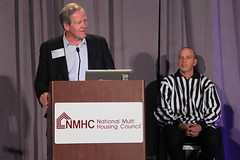
2010 NMHC Apartment Operations and Technology Conference & ExpositionOne of the key topics at the event was marketing, with a vigorous debate on whether social media is a productive outlet for apartment firms. While apartment executives may disagree about how much of a firm's resources should be allocated to social media, they generally concurred that there is a major industry shift underway in how the industry communicates with its customers.

During a debate on the pluses and minuses of social media, Jamie Gorski (The Bozzuto Group) argued that social media is crucial because it “protects and extends your brand” and lets you hear what your customers are saying about you. "To say that it hasn't generated any leases is missing the point. Social media is just another form of communication with your customer," said Gorski. "Would you not answer an email?"

AvalonBay’s Kevin Thompson said that social media augments your firm’s marketing plan, making your company more relevant: “Search engine optimization and enhanced customer service alone make social media worthwhile.”

Arguing the other side, Donald Davidoff (Archstone) replied that social media creates a lot of activity but not a lot of results and isn't easily quantified. Asked whether social media could be an external link strategy to drive traffic to the company's web site, Davidoff reported that bounce rates from Facebook are twice as high as from an ILS.

Todd Katler (BRE) concurred that there are lots of ways to keep your apartments full that don't involve Facebook or Twitter, plus social media is not scalable. Both agreed that they may feel differently in three years and conceded that it is important for reputation management.

Thompson said firms should “either embrace social media or don’t do it at all. Don’t do it halfheartedly. If you do it and don’t do it right, it’s worse than not doing it at all.” To be successful, stop thinking of yourself as a marketer and start thinking of yourself as a publisher.

Despite the disagreement, it was clear from the hallway conversations and other panel discussions that figuring out social media is high on the industry's "to do" list for 2011.

Industry Needs to Embrace Apartment Ratings

One thing the social media panel agreed on was the importance of embracing apartment rating sites like ApartmentRatings.com and Yelp because apartment residents are using them to make leasing decisions and they have enormous relevancy in organic search results.

Drucker & Falk’s Dan Haefner shared their initiative to get supportive residents to post ratings. He says the company has spent less than $200 a site on education and awareness building and has gone from a 20% rating to an 80% rating. Once they get above 80%, they link the property site to the ratings site.

What's the Next Big Thing? QR Codes

Last year's buzz word — mobile marketing — was still a hot topic this year, but firms report that their mobile applications are getting more traction with existing residents. Greg Lozinak (Waterton Residential) reports bounce rates (users clicking away from the front page) of 50% for prospects with their mobile campaigns, but just 30% for residents. Lozinak reports that 61% of their resident portal traffic is mobile, compared to just 39% of prospect traffic.

He explains that today's renter cohort is more likely to leave their apartment without their wallet than their cellphone. "It's their first screen of choice" he says.

This year's buzz was about QR (Quick Response). These easy-to-produce bar codes can be added to brochures, billboards and web sites. They can store text (instant coupons), URL links, geographic coordinates and more, and anyone with a smart phone or a mobile phone with a camera can scan them. Research reports that 71% of consumers polled are willing to download and use mobile bar codes.

Lynette Hegeman (Gables Residential) reports they are building a mobile landing page prospects would land on after scanning the code. They are also developing one for residents and using it to link to Facebook, maintenance requests, event calendars and more.

When asked "What's next?," one speaker advised: "If you want to know what's next, go to a college campus and see where technology is headed."

Don't Forget the Current Residents

Despite a noticeable emphasis on marketing, using technology to serve existing residents was a common theme. As Laurie Baker (Camden Property Trust) said, "residents find us online, can apply online, then they move in and we put notes on their doors." In focus groups, residents told them they hated having notices put on their doors.

When asked about budget priorities for 2011, firms cited using technology to drive resident retention and create a better user experience. This includes allowing online renewals, deploying revenue management for renewals and creating touch points at different times in the relationship.

Reiterating last year's takeaway, panelists said repeatedly that the way the industry communicates with existing residents has changed. Half want to be communicated with via text or email. But the industry needs an IT solution for resident communications. Property management systems don't have fields for Twitter or Facebook accounts or the ability to designate preferred communications, much less act on them.

Revenue Management

Another recurring conference theme was revenue management software and the way it's transforming the industry.

During the downturn, some companies disabled their revenue management due to fear that it would lower rents too quickly. Riverstone's Walt Smith said he could count on his fingers the number of clients who trusted it when rents were going down.

But AvalonBay’s Leo Horey said revenue management “works through all phases. But these are tools and they have to be used in conjunction with other tools and systems. Don’t just turn it on and let it go; adjust it.

Mutz agreed, saying it’s an amazing technology if it’s used right. Now his firm is working on rolling out a module for renewals.

Best Technology Advancement

Opinions varied about what the most important advancement in the past five years has been. Mark-Taylor’s Dale Phillips said online availability is the key: “Not just digital pictures of the floorplan, but an interactive display that can show how far the unit is from its parking space and other details.”

One sign of how far the industry has come in just a few years: Mutz said 67% of his firm’s leases this year will be online. “Three or four percent of the time we first meet a new resident when we hand them the key, just like a hotel.” Many of these sight-unseen renters tend to come from overseas, so making your web site available in different languages definitely appeals to them.

Mutz added that online leasing/marketing is important but said that data mining is “light-years ahead of 10 years ago.” Using a Human Resources example, he said: “Every employee gets a grade on 10 metrics, and each position has its own metrics. The key is: don’t make them drink through a fire hose, get it down to more manageable bite-size amounts so they can change their performance.”

Missed a session? Catch up!

Presentations from the conference are available to NMHC members here. Visit NMHC's Flickr Page for photos from this year’s event. The Council has also created a Social Media Listserve to allow members to exchange ideas and pose questions on the topic. For more information, visit www.nmhc.org/goto/socialmedia.

Mark Your Calendar for Next Year!

Next year’s 2011 NMHC Apartment Operations and Technology Conference & Exposition will be held in Fort Worth, TX, November 6-8, 2011 at the Omni Fort Worth.

What are your top technology priorities for 2011? Does marketing top the list, or are you more focused on operational issues? Leave your takeaways in the comments.